



Revival of Iron City beers
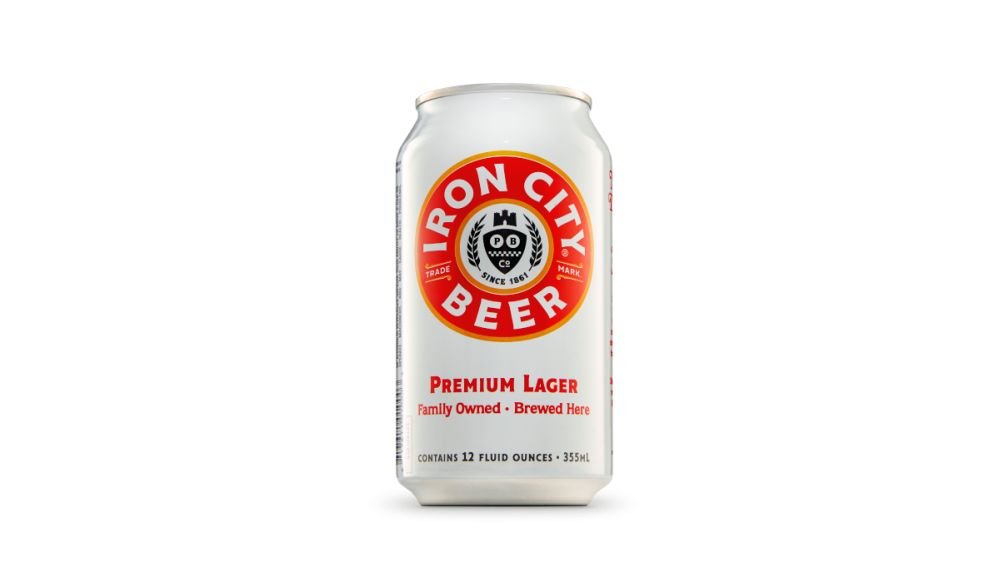
The 160 year old Pittsburgh Brewing Company is known for its popular lager, such Iron City, IC Light and IC Mango. (photo: GEA)
The 160-year-old Pittsburgh Brewing Company is known for its popular lagers, such as Iron City, IC Light and IC Mango, which were previously produced at other sites. “Doing all the brewing ourselves from now on is a big step. The learning curve is huge,” says Todd Zwicker, President of Pittsburgh Brewing Company. “We relied on GEA, and today we are proud of our iconic brewery – a project that we managed to complete on time thanks to GEA, despite the pandemic and supply chain situation. We want to be a beacon project for our region with the participation of the local community.”
Pittsburgh Brewing has big plans for its new production site for brewing process on the Allegheny River. Not only will the company increase core production from the current 100,000 hectoliters of beer per year, but former brands will be revived and new ones created. The capacities can also be used by other breweries. “We want to add weight to our brands, but focus on our local core sales region,” Zwicker explains. Pittsburgh Brewing currently delivers 90 percent of its production volume to West Virginia, Ohio, Pennsylvania and Maryland.
Brewing process; high-tech behind brick walls
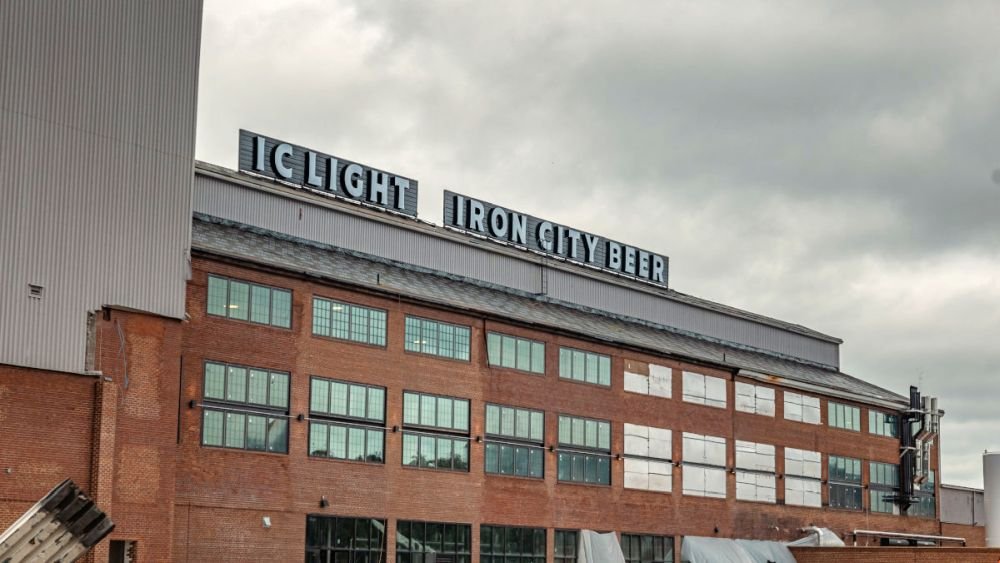
The building, originally a glass factory on the Allegheny River, provides ample room for Pittsburgh Brewing to fulfill its dreams. In addition to the brewery, which has now become reality, a museum, restaurants and distillery are in the planning stages. (photo: GEA)
Pittsburgh Brewing’s new brewery is housed in an old glass factory. The 42-acre property provides enough space for the brewhouse, the huge tank farm with 100 BBL brewing tanks and 500 BBL fermentation and bright beer tanks, the filling and packaging plants, and additional retail space. The new brewery is set to start operation in August 2022, fully equipped with GEA machines and components: These include the GEA COMPACT-STAR craft brewhouse with five vessels, the GEA MILLSTAR wet grist mill, a GEA WORTSTAR for wort aeration, a yeast propagation unit, the GEA Plug & Win craft centrifuge and other equipment for cleaning and pasteurization, blending, carbonation and bottling.
Planning for constant capacity utilization in the future
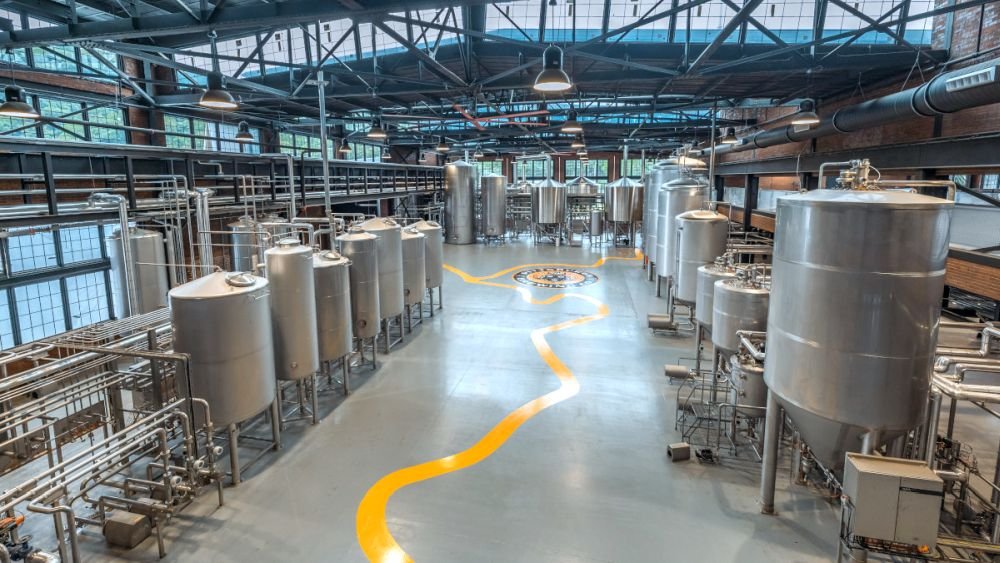
Pittsburgh Brewing’s new brewery is housed in an old glass factory on the Allegheny River. It is fully equipped with GEA machines and components, including the GEA COMPACT-STAR craft brewhouse with five vessels. (photo: GEA)
To ensure a reasonable expansion of its portfolio and annual output, GEA also prepared capacity planning for Pittsburgh Brewing that avoids supply peaks and forms the basis for lower water consumption in production. “The most efficient breweries are those that achieve and maintain a constant production level with a high brew frequency at an early stage,” explains Andreas Holleber, the head of GEA’s brewing business. “The higher the number of brews and the shorter the brew cycle, the lower the investment and operating costs. We help the customer avoid oversizing the equipment.” The new plant for brewing process is designed for modular growth. Phase 1 provides for 150,000 hectoliters (about 94,350 bl.) of annual output, which will grow to up to 500,000 hectoliters (about 314,500 bl.) in phase 3. This will make Pittsburgh Brewing one of the largest breweries in Pennsylvania.
GEA technology allows for flexibility and variability
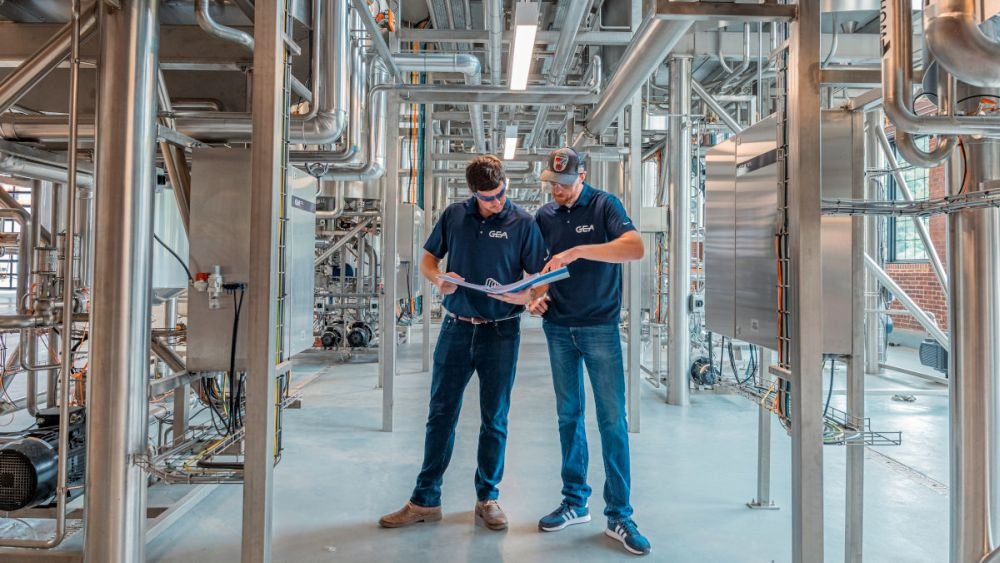
GEA began installation of Pittsburgh Brewing’s new brewery in August 2021 and handed it over to the customer one year later. (photo: GEA)
It was particularly important for the brewing company to design the plant to be as versatile as possible, both to change the product range quickly according to consumer requirements and to make the best possible use of capacities. The GEA DICON inline blender is one of the workhorses in the production area, which can also be used to produce soft drinks, for example.
Multi-talented filler
Pittsburgh Brewing also opted for a multifunctional filling unit: The combined rinser-filler-capper block GEA Visitron ALL-IN-ONE allows for maximum flexibility and reliability in the production of small and medium volumes. With its very small footprint, it rinses, fills, seals and seams cans and glass bottles using 64 filling heads. Brewers can switch between different bottle and can formats in as little as 20 to 30 minutes.
Waste-free filtration with ceramic filters
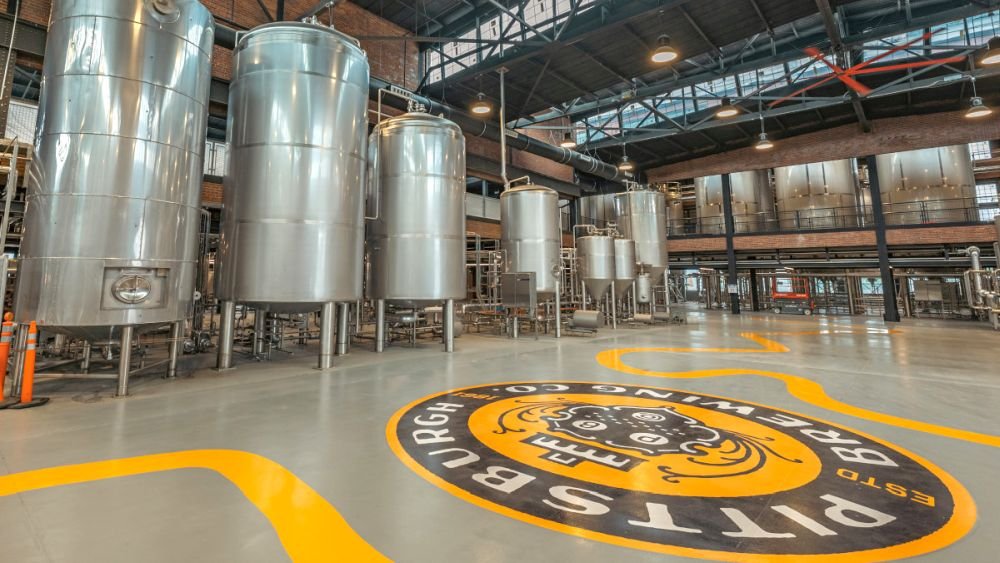
From this point on, Pittsburgh Brewing will produce its popular lagers, such as Iron City, IC Light and IC Mango, in this new facility. They had been previously produced at other sites. (photo: GEA)
Pale lager beers need to be filtered to achieve a longer shelf life and the desired clear, lustrous appearance. As a sustainable alternative to common diatomaceous earth filtration and cross-flow filtration with polymer membranes, Pittsburgh Brewing has invested in the GEA clearamic BeerFiltration solution. The plant works based on the cross-flow principle and is equipped with pressure-resistant, inert and extremely durable ceramic membranes proven in yeast recovery and fruit juice filtration. GEA was the first to adapt this waste-free process for beer filtration. This technology allows brewers to transform during the brewing process the complex and originally cost-intensive filtration step in the cold area into a cost-effective and environmentally friendly process.
