



It is for this reason that many companies are investigating the flexibility and capabilities delivered by automated secondary packaging. Not only does automation cater for these higher throughputs, but it also delivers higher and more repeatable accuracy and quality and greater cost effectiveness, while normally occupying far less factory real-estate.
The rule books for the secondary packaging for bakery
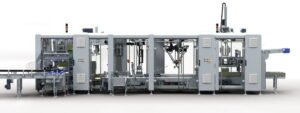
The monobloc machine exploits the design rationale behind Cama’s Breakthrough Generation (BTG) concept. (photo: Cama)
Many incorrectly presume that speed and throughput come at the cost of flexibility, but Cama Group has proven this to be false at a North American baked-goods company, thanks to a packaging solution that has rewritten the rule books, revolutionising the customer’s secondary packaging operations.
Not only does the Cama solution address the need for higher throughout, but it does so with a more efficient packaging design and in a smaller-footprint monobloc machine that replaces two previous installations. What is more, the customer has a choice of packing products into cartons and then six cartons into cases, or simply packaging 6 or 12 loose products into cases, thanks to a bypass solution incorporated in the machine’s footprint.
The US company produces baked goods, which are presented in trays and sealed into bags gathered at the neck. Growth in its home market has resulted in an uptick in demand for its products and, as a result, it was looking for a highly capable and fully automated secondary packaging system to replace its existing manual + machine operations.
The customer was comfortable with its existing primary packaging design and did not want to change the presentation of its secondary packaging, some of which comprises multipack cartons which can be modified into shelf-ready trays.
Developed a wraparound carton, formed and fed from a blank magazine, in a process that is far less complicated
According to Davide Di Lorenzo, Sales Engineer Manager at Cama Group: “The customer was happy with its existing shelf-ready presentation for certain packaging formats, but was using pre-glued RSC cases, which place far greater demand on packaging operations. Our packaging design team worked with the customer to develop a wraparound carton, which offered identical aesthetics and shelf-ready tear offs but could be formed and fed from a blank magazine, in a process that is far less complicated and takes up less real estate.”
In operation, the machine receives the frozen bagged baked goods from the downstream bagger. A vision system detects the position of the bag tails before they are inserted into the concurrently formed wraparound carton, the vision system ensures the robots orient the packs in such a way that the tails are positioned near the hinges of the carton, preventing them from fouling any of the glue points. The cartons are then closed before being transferred to an integrated wraparound case packer, where they are packaged ready for shipment.
The customer also required a solution where 6 or 12 products are loose packed directly into cases, which exhibit different dimensions depending on the height of the product being packed – one is 38 mm the other 52 mm. Cama was able to achieve this functionality in the same machine envelope by incorporating an integral bypass conveyor, which takes the loose products around the carton packaging stage and straight to the case packing. Once again using a robots and vision systems to ensure perfect orientation, packing and closure.
100% digital platform to support full industry 4.0 capabilities for the multi function monobloc machine
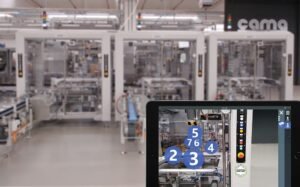
The machines are based on a 100% digital platform that supports full Industry 4.0 capabilities, including AR, VR and virtual testing, training and operation. (photo: Cama)
“This multi-function monobloc machine not only meets the customer’s needs in terms of throughput, but it does so with many other value-added advantages,” Di Lorenzo explains. “Not only are material and material-stocking costs far cheaper, but the machine also takes up less space and the employees it replaces can be moved to more value-adding activities.”
The monobloc machine exploits the design rationale behind Cama’s Breakthrough Generation (BTG) concept, which sees modular, scalable and hygienically designed frameworks housing contemporary automation solutions. This includes advanced servo technology, which is tightly coupled to vision systems and Cama’s robotic solutions, which have been developed in house to deal with the specific demands of secondary packaging.
The machines are also based on a 100% digital platform that supports full Industry 4.0 capabilities, including AR, VR and virtual testing, training and operation. Furthermore, advanced component-identification systems can deliver rapid format changeovers, sometimes in as little as 15 minutes.
Cama North America exhibits its secondary packaging innovation, including augmented reality, at Pack Expo International
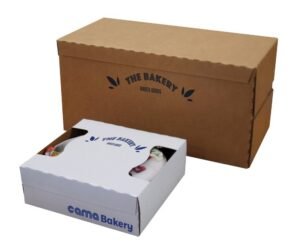
Cama Group revolutionises secondary packaging at leading North American baked goods company. (photo: Cama)
For CPGs and other manufacturers looking to improve production and efficiency, Cama offers innovative secondary packaging systems designed for ease of use and flexibility. Cama’s flexible cartoning, case packing, tray packing, and robotic loading systems are designed to easily run multiple products and package sizes with quick and easy changeover.
Cama North America exhibits its Model IF315 top-loading system with integrated robotic orientation, robotic loading, cartoning and wraparound case packing functions within a monoblock frame, including its vision-guided RB590 Triaflex delta style robot. This system is ideal for packing flexible or rigid product in both secondary and tertiary packaging in a compact framework.
At this year’s Pack Expo, Cama will also showcase the next evolution of its class-leading augmented reality (AR) technology. With AR and virtualization already proving invaluable across the design, build, commission, test and operational phases of its BreakThrough Generation (BTG) line of cartoners, case and tray packers, and sleeving systems, Cama now offers immersive, line side support for warranty, spares and consumables, through its Augmented Machine Assistance Package.
Visit Cama in Booth S-3386 at Pack Expo fair in Chicago for live demonstrations and to learn how they can help business improve product throughput, efficiency, sustainability and more.
Info about Cama North America
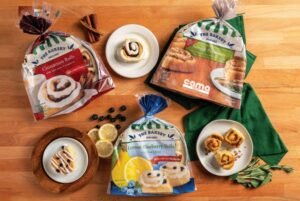
Cama’s expertise spans a wide range of applications, including bakery, confectionery, coffee, dairy, grocery, ready to eat meals, and pet food, as well as personal, health and home care. (photo: Cama)
Buffalo Gove, IL-based Cama North America is a subsidiary of Cama Group, Lecco, Italy. Cama is a leading supplier of secondary packaging, robotic systems, and integrated packaging solutions for a wide variety of markets, including food packaging and nonfood applications. Their product line includes case packing systems for RSC, wrap-around and display cases; forming, closing and lidding machines for boxes, trays and RSC cases; intermittent and continuous motion cartoners; carton sleeving machines; and integrated decoupled and monoblock robotic loading units.
Cama’s expertise spans a wide range of applications, including bakery, confectionery, coffee, dairy, grocery, ready to eat meals, and pet food, as well as personal, health and home care. Cama has more than 30 years’ experience supplying food packagers and other customers with innovative solutions that help improve efficiency and optimize production. Cama North America serves the United States and Canadian markets, providing local engineering, manufacturing and aftermarket services, including technical service, programming and parts. We take pride in our long-term customer partnerships and consultative approach to providing customized systems using proven, modular state of the art technology.
